Devlog: System Design Thinking in my Game
On Limits, Loops, and Emergent Play

Why Systems
I’m at the stage of making my game where I’m questioning everything. Not really the idea of whether I should have an inventory (yes), but thinking about details like “should the player have stamina?”, “Should the merchant be available all the time or only some of the time?” “What are the consequences if I make the sanctuary area smaller? or bigger? or infinite?”.
I’m questioning them because I’m really getting into the fun part of the game design and guiding how the player will interact with the mechanics I’ve built in early-mid-or late game. Each design choice I make will affect how a player progresses and whether or not that progression is meaningful, and ultimately fun. I’m also probably overthinking it.
To keep myself grounded, I’m starting to think about the game as a system. Rather than isolate each mechanic, I’m viewing them in terms of their interaction and feedback over time. System design helps me frame these decisions: What does this mechanic encourage? What happens when it's pushed to its limit? How does it interact with the others?
At the moment, I have a relatively small test area that I can do several things as a player. I can dig out sod, plant plants, take pictures of birds, sell items to a merchant and buy new plants. Generally this puts me into a game loop of
Dig out ground → plant plants → take a picture of a random bird → sell it → buy new plants → Repeat
It’s not a bad loop, but there are a number of things missing to actually make it fun.
Currently it lacks a strong feeling of progression. I have not enabled the player to know how the environment affects what birds appear, so as a player I don’t have a clear goal in mind with the habitat. Other than their own creative drive to make it look nice.
There aren’t enough reasons to do anything else. Not that there are a lot of other options at the moment (because I haven’t made them…), but the player could spend an entire play session just digging out the entire area. And there’s not really much to stop them from doing so.
Money isn’t really an issue. Players can take photos of birds and can keep taking photos as long as they want. Nothing stops them from taking more and making more money.
In other words, it’s not very fun. So do I throw it all out? NO! I just haven’t put in any meaningful limiters to the game loop. And that’s the long and short of where I’m at with the game. I have the core mechanics as I envision them in the game currently, but it is not a game without meaningful rules and goals.
Limits and Resources as Design Tools
In every game there are limiters or rules that govern the experience. In Minecraft, for example, there are limits on your health and hunger. These influence the player to build a shelter (to avoid losing health to enemies) and make a farm (to replenish hunger). In Stardew Valley there are limits on stamina and money. These limiters give the game structure and encourage choices.
For the Birds (new working title for the game :D ) is going to be an example of taking a relatively simple goal: build a bird sanctuary, and make it into an exercise in balancing stamina, money, time, and space. Each game mechanic relates to the other and every design change will shift the game play. If the systems are done right, they give the player a reason to plan, experiment, and grow.
In For the Birds, the mechanics show up like this:

Each resource, like money, generally has a corresponding limiter. If I sell photos, I get more Money. However to sell photos, I need to spend Stamina and Time to plant plants, attract birds, sneak up on them, and take their picture. And I can only do that if I have enough Space. So all of the systems - how much stamina I have, what space I allow, and how much time you have to do it - affect how much Money you are able to make and at what speed. For me, thinking about the game as a system of resources the player wants to increase and a series of limiters that slow the player or encourage the player to try other approaches helps in structuring my design decisions around the game.
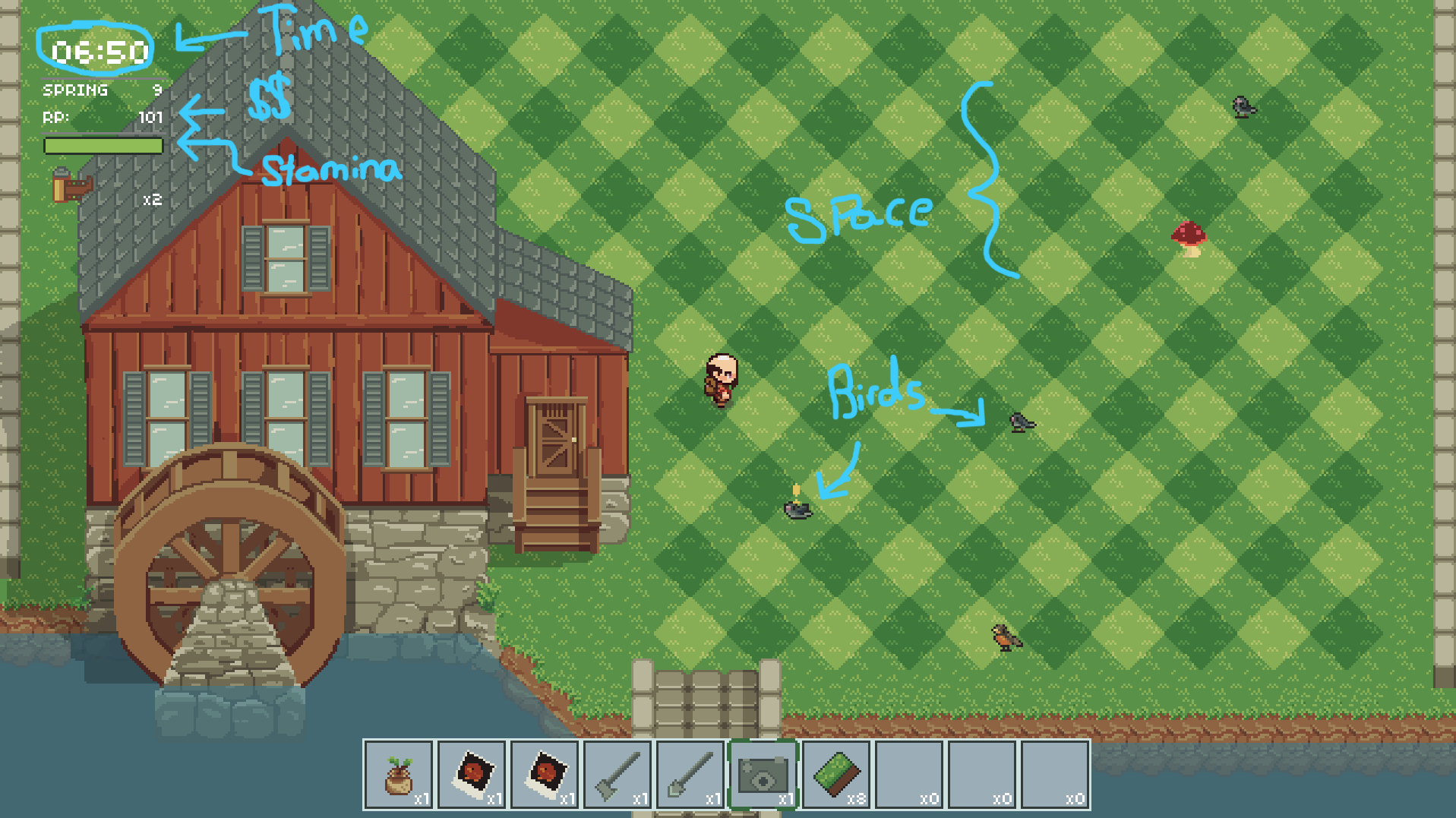
The limiters of the game are currently something like this:
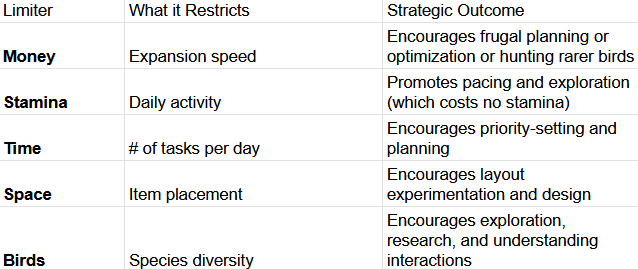
Each limiter encourages pacing and strategic planning. When one resource is low, the player is nudged toward another system. Out of stamina? Exploring to forage, find new areas, or talk with people may unlock new ways to get money. Can’t afford a new tree? Spending time searching for and photographing rare birds may be more lucrative than photographing common birds. These are the kinds of design levers that I’m starting to sketch out and implement.
Interlocking Systems & Emergent Strategy
Here’s the structure I’m aiming for:
- Trees provide habitat → which attracts birds
- Birds arrive based on environmental thresholds (e.g. water, food, canopy)
- Taking photos of birds earns Money → which fuels planting more habitat
- Some birds appear only if multiple systems are aligned: e.g., they have the correct number of bugs with the right amount of water and their friends are there
- Stamina limits how much you can do in any given day on the sanctuary itself
This interlocking structure is where the fun starts. With a relatively coherent set of rules governing the ecosystem of attraction the player begins forming strategies, learning through play, and personalizing their approach. They have a limited amount of resources, and so must make decisions like “do I buy another oak tree or should I plant more grass?” To make these tradeoffs they need to know what kind of space they’re working with and ideally what the benefits might be towards investing in delayed rewards like long growing trees or large objects that may not produce much right away.
An Example
Let me be extra concrete because I made these animations and I don’t want them to go to waste. If you have an area that is just 10x10 tiles, as a player you’d have to be pretty particular about what you plant there. You’d also want some payoff depending on what you planted. So let’s think about planting an oak tree. If I make an oak tree produce a whole lot of bugs, shelter, shade, seeds, and other things, it could be a big attraction for rare birds. If it’s really easy to acquire, the player will opt for that option over anything else. So I make it cost something as sort of an economy of habitat items. I (as a developer) can make it so the oak tree occupies a little + shape when it’s fully grown, take more time to grow and make the item cost more at the merchant. These limiters make it so the player has choice in what they plant and need to be strategic in how they utilize the space.
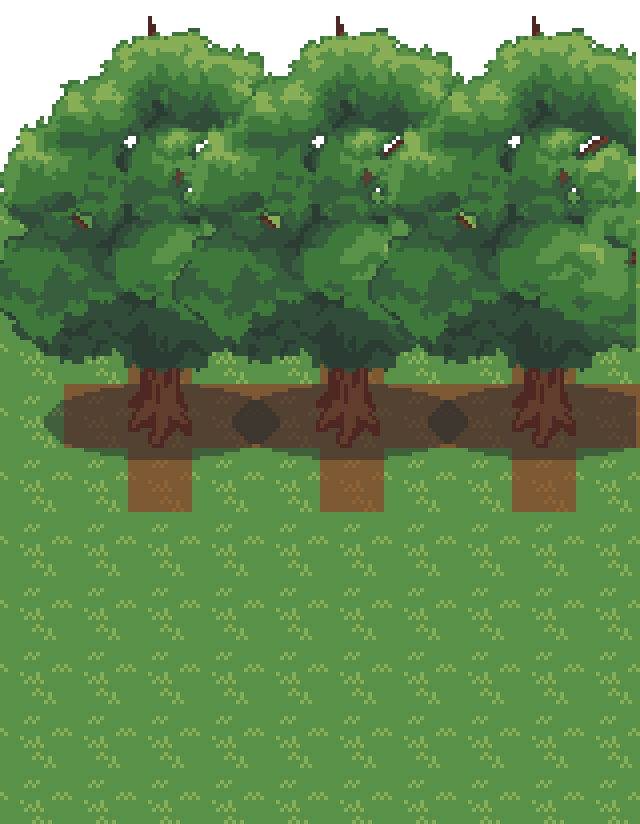
If you only plant oak trees, you can fit around 9 in the space. You can also squeeze in a few other 1x1 items in the spaces between (technically you probably can plant diagonally and fit more in than I showed, but I didn’t check…). Thinking about this, I’m kind of outlining a way to make it so each item has a certain “bugs/tile” benefit while having a “stamina/tile” and “money/tile” and “time/tile” cost. This is probably getting too into the weeds (ha) and maybe it won’t make a big difference in the end, but I needed a place to start thinking about what items cost and how they motivate the player.

Aside from the actual progression of acquiring trees and planting them, what’s still missing is a strong sense of informational progression. Players need feedback to help them understand the systems and set goals. That’s where the Journal system comes in.
The Journal System & Player Knowledge
Thinking of this as a system has clarified that I need to expose these systems to the player to help them set their own goals in building the habitat. I’m thinking of the journal as a sort of informational meta-game. Discovering a bird unlocks data about what it needs. This lets the player know what kind of habitat they should build, then they can experiment with different habitats in order to attract the discovered bird.
Probably just as importantly, I need to reduce randomness. Right now, bird appearances feel chance-driven. I want players to have more agency in influencing what birds appear and why as well as what birds stay in the habitat and why. That means tightening the attraction system and making the habitat-building process more transparent and rewarding.
I recognize a lot of this system thinking is a bit abstract since there is currently not a version I can share so we’re doing a lot of “theater of the mind” exercise in thinking about how systems interact and theoretically could interact. But well… that’s where I’m at with the game and I wanted to document that aspect in the development journey as well!
Bonus from my sketchbook playing with ink and crosshatching: